Coarse-to-fine uncertainty reduction for robotic disc cutter grasping in TBM maintenance
Abstract
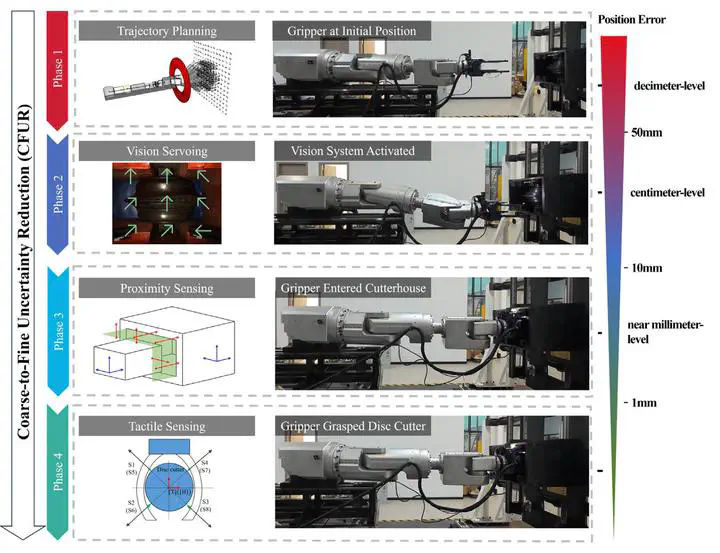
Robotic disc cutter grasping in tunnel boring machine (TBM) maintenance is challenged by large initial pose uncertainty, occlusion, and harsh underground sensing conditions. This paper proposes a coarse-to-fine uncertainty reduction framework that progressively refines the grasp pose of heavy disc cutters. A coarse stage localizes the cutter under substantial initial uncertainty, while a fine stage reduces residual pose errors through multi-sensor fusion and adaptive grasping control. The approach improves grasp reliability for automated cutter replacement and is validated in TBM-oriented experimental settings.
Type
Publication
Automation in Construction