Planning 6-D Grasps for Two-Finger Grippers Considering Edge and Corner Contacts
Abstract
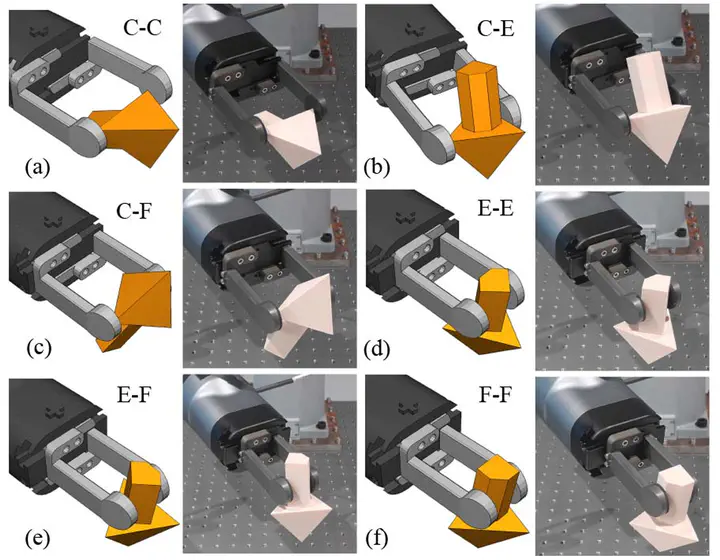
This article presents a novel model-based algorithm for planning antipodal grasps, especially considering the edge and corner contacts. Conventional model-based planners search for face contacts to build grasp synergies, which ensure superior grasp stability, but inherently restrict the geometric versatility of feasible grasp configurations. With soft contact, edges and corners can reshape fingerpads to form equivalent face contacts, enhancing the ability to resist gravity. This allows candidates with greater configuration variability, rather than being constrained solely by face normals. The developed planner detects regions of faces, edges, and corners from a computer-aided design (CAD) model, samples contacts from each region, detects paired contacts using contact detectors corresponding to contact types, and screens the pairs by stability and collision checking. It generates grasp candidates with qualified stability and flexible configurations, breaking the limits of planning for polyhedra, asymmetric objects, and objects with various sharp angles, etc. Experimental results quantitatively demonstrate that the proposed method has superior performance on grasp distributions and success rates using the selected objects from open datasets and off-the-shelf items.