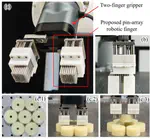
In this letter, we addressed the grasp challenge in clustered-object environments, where narrow inter-object clearances constrain finger insertion and the sensory perception is unreliable. We proposed a pin-array–based robotic finger that passively adapts to local object geometry, enables insertion into surrounding clearances, and tolerates pose uncertainty. A parameterized finger design was developed and prototyped, and the graspable payload, adaptable uncertainty, and clearance capability were modeled. FEA was used not only to validate mechanical robustness but also to explore the limits of miniaturization under extreme loading conditions. Quantitative experiments showed that the proposed fingers can successfully adapt to the minimum clearance of 4.1 mm (within ±5 mm positional errors). Extensive grasping experiments on 8 representative object categories demonstrated robust and stable grasping performance in real scenarios, achieving an overall success rate of 93.3%. In addition, fully autonomous experiments with randomly scattered components verified that the proposed finger can be integrated into a closed-loop grasping system and successfully operate in realistic cluttered environments.