2

Voxel-LIVO: Accurate and Robust LiDAR-Inertial-Visual Fused Odometry and Mapping in Challenge Environment
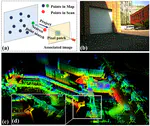
In this article, we propose a novel LiDAR-inertial-visual fusion framework, named Voxel-LIVO, which is capable of real-time dense map reconstruction while achieving accurate and robust state estimation. The framework tightly fuses measurements from three heterogeneous sensors via an IESKF and, through a unified hybrid-map strategy, maintains short-term, mid-term, and long-term data association. The system maintains high-precision localization, remains robust to LiDAR and/or visual degeneration, and keeps its memory footprint low. The improvement in system accuracy is attributed to the extraction of high-quality image patches, coupled with affine transformations of those patches guided by LiDAR planes, which markedly enhance image-alignment precision. Additionally, the system further optimizes the state using sequential LiDAR-visual BA. The improvement in system robustness is attributed to both the LiDAR and visual subsystems adopting direct methods, which can capture subtle changes in geometric and visual features. It combines multiple frames of LiDAR and camera within the window to strengthen data association, and projects the local point cloud map onto the image to counter the impact of LiDAR being in blind spots. Voxel-LIVO is tested on a wide range of public datasets and our private datasets, evaluating its performance in terms of localization accuracy, robustness, and point cloud map precision. The results show that Voxel-LIVO achieves the highest accuracy among all the compared state-of-the-art SLAM systems. Furthermore, Voxel-LIVO demonstrates excellent robustness in highly challenging scenarios, particularly when LiDAR and/or camera measurements are degraded.
Tightly-Coupled LiDAR–Inertial Odometry with Geometric-Uncertainty Modeling
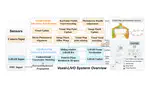
In this article, we propose a novel LiDAR-inertial-visual fusion framework, named Voxel-LIVO, which is capable of real-time dense map reconstruction while achieving accurate and robust state estimation. The framework tightly fuses measurements from three heterogeneous sensors via an IESKF and, through a unified hybrid-map strategy, maintains short-term, mid-term, and long-term data association. The system maintains high-precision localization, remains robust to LiDAR and/or visual degeneration, and keeps its memory footprint low. The improvement in system accuracy is attributed to the extraction of high-quality image patches, coupled with affine transformations of those patches guided by LiDAR planes, which markedly enhance image-alignment precision. Additionally, the system further optimizes the state using sequential LiDAR-visual BA. The improvement in system robustness is attributed to both the LiDAR and visual subsystems adopting direct methods, which can capture subtle changes in geometric and visual features. It combines multiple frames of LiDAR and camera within the window to strengthen data association, and projects the local point cloud map onto the image to counter the impact of LiDAR being in blind spots. Voxel-LIVO is tested on a wide range of public datasets and our private datasets, evaluating its performance in terms of localization accuracy, robustness, and point cloud map precision. The results show that Voxel-LIVO achieves the highest accuracy among all the compared state-of-the-art SLAM systems. Furthermore, Voxel-LIVO demonstrates excellent robustness in highly challenging scenarios, particularly when LiDAR and/or camera measurements are degraded.
Sensorless Payload Estimation of Serial Robots Using an Improved Disturbance Kalman Filter with a Variable-Parameter Noise Model
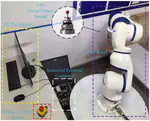
In the paper, we present a novel sensorless disturbance Kalman filter DKF for accurately estimating the different payload exerted on the end-effector of serial robots. The DKF employs a generalized momentum-based dynamic model of robots that incorporates velocity- and load-dependent nonlinear friction, achieving superior performance in external force estimation. A classic Kalman filter framework is adopted to effectively implement the approach. Furthermore, the influence of load, friction, and velocities on noise parameters within the Kalman filtering algorithm is explicitly considered through a variable-parameter modeling of the noise term, thereby enhancing the overall performance and adaptability of the DKF. Comparative experimental results of multiple external load observations for the robotic end-effector demonstrate that the proposed OKF observer achieves significant improvements in dynamic performance, such as response speed and overshoot, over both the BKF observer and other existing methods. In the design of the external load observer for robotic end-effectors, our study only addresses loads with constant or slowly varying mass, which limits application to highly dynamic scenarios. In practice, loads may change unpredictably in more complex ways. In future work, we will extend this research to more complex and dynamic loading conditions. Moreover, we plan to integrate unidirectional pressure sensors, which could assist in integrating the DKF into a force controller, enabling tasks like collision detection with payloads and assembly.
Visual Servoing With Grid‐Based Directional Error Mapping for Robotic TBM Disc Cutter Replacement
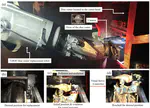
In this paper, we proposed a visual servoing method that considers the image gridding as the features based on whole image data rather than extracting any geometric features or reconstructing interested objects, which shows a robust performance and is convenient for deploying. By classifying each gridding and reorganizing the mapped vectors, we built the desired vector field corresponding to the camera motion and then transformed it into visual servoing signals. Overall, our method has three main advantages. First, it takes the benefit of the data driven method (in the classifying process), which significantly simplifies the controller design. Second, by using a constant Jacobian matrix that maps the output velocity from the desired vector field, we expand the flexibility of output velocity compared to the normal classifier‐driven method. Finally, it inherently strengthens the adaptability of the controller in complex environments and uncertain conditions by using gridding, as each gridding takes the weight for the motion separately. Still, many works can be investigated. The gridding number needs to be further studied as it directly influences the smoothness of the output velocity and the complexity of the closed‐loop controller. VAE−KNN affects the controller’s performance and can be further studied. Furthermore, the Oscillation Detector also needs to be investigated to complete the servo task adequately and intelligently. Moreover, although we reached a desirable performance in helping the disc cutter replacement, the behavior of our method under a completely different domain still needs more verification.
Adaptive Neural Computed Torque Control for Robot Joints With Asymmetric Friction Model
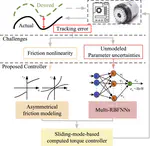
In this letter, we present a tracking control strategy for torque-driven joints to accurately execute the trajectory tracking of joints for a changeable task in an unstructured environment. This scheme incorporates the sliding-mode-based CTC, RBFNNs, and feedforward friction estimation, mainly consisting of two levels:1) feedforward level − we establish a new asymmetrical model for velocity-, load-, and temperature-dependent friction phenomena; 2) training level − multiple RBFNNs further estimate a joint system’s dynamic uncertainty and nonlinearity separately. Experimental results demonstrate that the proposed asymmetric friction model has a significant improvement in terms of friction compensation; the designed semiparametric scheme synchronously exhibits superior trajectory tracking performance in the joint space.However, this study does not consider the issues of fluctuated disturbances and input saturation. In future work, we will further optimize the control algorithm from the following two aspects:1) using a unified linear regression approach to identify dynamic parameters with the proposed friction model; 2) improving the sliding mode surface to ensure finite-time convergence of trajectory tracking errors. We will apply the optimized control algorithm to trajectory tracking of serial robots installed in the target scenarios.
Lie-theory-based dynamic model identification of serial robots considering nonlinear friction and optimal excitation trajectory
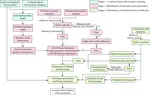
In our work, a Lie-theory-based accurate dynamic modeling scheme is given for multi-DOF serial robots with/without external loads, where we propose the improved Stribeck friction model involving the nonlinear dependence of friction on the velocity–load and introduce a novel linearizable nonlinear dynamic model. On the basis of the interaction between different optimization criteria, we modify the optimization technique for the design of optimal excitation trajectories used in dynamic identification. Finally, several experiments are carried out on the seven DoFs Franka Emika robot, and the experimental results reveal twofold:(1) the proposed dynamics scheme has better fitting accuracy and higher versatility and (2) the optimal excitation trajectory generated via the proposed criterion requires shorter optimization time while ensuring the quality of identification results compared to others, which can provide advantages for fast, robust, and accurate identification.In the next work direction, the time-varying temperature-dependent friction phenomena will be researched for fine modeling and compensation. Simultaneously, the developed friction will be seamlessly extended to the dynamic friction model and applied to robot dynamics in a unified way. Concurrently, there is a need for further exploration at the robot planning level in conjunction with advanced intelligent control theories.